Friday, 8 November 2019

Ferguson's Cake Shop, Coburg

From the Ruskin's All About Coburg, 1953.


Ferguson's Cake Shop was a go-to destination for my family in the 1960s. We didn't have far to go - we lived diagonally opposite. Regular buys were vanilla slices, apple slices, Boston buns and chocolate eclairs. Yummo. And all because my mother went to work at Myer in the city and no longer had time to bake. Oh yes, and my father had a very sweet tooth!

There was also a fish and chip shop just down Bell Street (same side of the road) somewhere near the railway line. Lots of kids from Coburg State School went there on Fridays to buy potato cakes and chips. This must have been in pre-decimal currency days because I'm pretty sure I was given sixpence to spend on lunch on those rare occasions when I didn't go home for lunch. (Lived right next to the school, so no excuse, really.)

Does anyone else have their own favourite memories of Fergusons? 


Monday, 4 November 2019

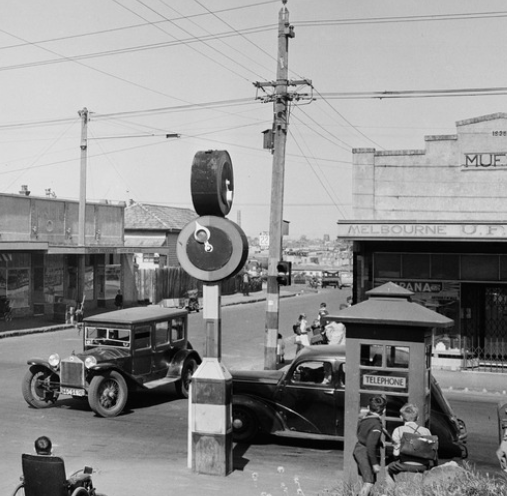
Corner of Blyth and Nicholson Streets, Brunswick East, 1949


Intersection at corner of Blyth Street and Nicholson Street, Brunswick, c1949. Photographer Lyle Fowler. Part of Harold Paynting Collection, State Library of Victoria. Image H92.20/3329.


What a wonderful photograph! So many things to grab the 21st century viewer's attention. The photographer, Lyle Fowler, was facing north-east in Blyth Street. To the left is the Lomond Hotel. There's a vacant block on the right foreground. Today this is the home of radio station 3RRR. 


On the right hand side of the intersection you'll see a 'clock' style traffic control signal. I don't think I've ever seen one before. The vehicle you see moving along Blyth Street is travelling west towards Lygon Street. Just behind the telephone box (red, of course) you can see the MUFSD (Melbourne United Friendly Societies Dispensary) building. It was built in 1935, so had been there over a decade by then. It's now a multi-storey building.


You can just see a bus travelling south along Nicholson Street in this close up. Today it's the 96 tram terminus.


The shop on the corner of Nicholson and Blyth Streets. It's McAlpin's Grocers shop. And if you look at the advertising you can see they sell Lipton's Tea, Peter's Icecream, Irish Moss, daily newspapers such as the Argus, the Sun and the Herald. This is the closest you'll get to the modern-day supermarket in 1949.


Next door to McAlpin's is Alf Roberts business. Unfortunately I can't make out the details of his business. Written across the window is 'Streb...' but there's a truck in front of the building, obscuring the rest of the word. 


The school children walking south down Nicholson Street have come from Brunswick East Primary School, just a little further down the road in Stewart Street. It's summer, but whether it's the start of the school year or the end is impossible to tell. If you look closely, you can see children on each corner of the intersection, reminding us that these were the days when kids walked to and from school without adult supervision. 

And if you'd like to see some great photos of Brunswick East Primary School taken a few years later, a selection from the Public Record Office of Victoria can be seen here. 

Finally, just so you can do a bit of now and then comparison, here's the original 1949 photo again followed by a photo taken in November 2017 (from Google). I couldn't quite get the angle right, but it's close.


1949

2017


Friday, 1 November 2019

Providing water, Fawkner, 1955


Hard to believe now, but in the middle 1950s, Fawkner residents were collecting water from a central point by bucket. Walking half a mile (0.8 kilometres) to get water to drink, to wash yourself or wash your clothes was quite a commitment. I like the ingenuity of the methods of getting buckets home - I can see a wheelbarrow, a billy cart (?) and a baby's pram here. 

Someone commented to me once that there's so little written on the history of Fawkner, so I've been trying extra hard to find material. It's not that easy, and I've relied mostly on newspaper reports, but of course the TROVE newspaper collection only goes to the middle 1950s, so after that it's a bit more difficult. 

So, if you've got any Fawkner-related material or memories of your own that you'd like to share, please let me know. (gcheryl52@gmail.com)


Tuesday, 29 October 2019

Moonee Ponds Creek, 1915


Two boys at the Moonee Ponds Creek, Brunswick West, circa 1915. 
Courtesy Museums Victoria. MM 111126.


It's hard to visualise now, when the Moonee Ponds Creek has been reduced to little more than a concrete channel in places, but since the first land sales in the area in the 1840s the Creek has been an important feature of this western perimeter of Brunswick and Coburg (and beyond). 

Perhaps you've never thought about why it's called Moonee Ponds Creek but it was actually a series of marshy ponds when European settlers arrived and this area was a large floodplain. Near its entry to the Yarra River (in the area known as Batman's Lagoon) its salt water marshes were extensive and early next year this area will be the subject of a major exhibition at the Royal Historical Society of Victoria. But more news on that later.

If you're interested in reading about the history of Moonee Ponds Creek, you will find more in Moreland Council's Thematic History of the area. You will find that here. It's a searchable document, so just search for Moonee Ponds Creek. There is much else of interest in this document, so beware - it's a bit of a rabbit hole!

The other resource you might find interesting is Moonee Valley Council's Our Moonee Ponds Creek website. You can look at that here. It doesn't just look back at the history of the creek, but outlines future planning possibilities and asks people to get involved. Well worth taking a look.

And if you'd like to read a little more about the saltwater lagoon I mentioned earlier, you could do no better than to seek out David Sornig's new book Blue Lake: Finding Dudley Flats and the West Melbourne Swamp. It's a terrific read and won the 2019 Judges' Special Prize at this year's Victorian Community History Awards. There's a bit of social history there, as well as the geographic. It's a neglected part of Melbourne's history and this book is a well worthwhile addition to your reading list. You can read more about the awards here. 


.


Sunday, 27 October 2019

297 Lygon Street, Brunswick East has been sold


Not long ago, on one of my walks around the area, I took these photos of the side wall of Carbone Master Tailors at 297 Lygon Street, Carlton. 


It was a pleasant surprise to see the Robur Tea advertisement still visible on the side of the building and it brought to mind the days when our family were almost exclusively tea drinkers and our preferred brand was Robur. 

Our neighbours were dedicated Lipton tea drinkers. It was always tea leaves, of course - I'm talking about the days before tea bags. They collected the cards that came with the packets of tea and I'd spend hours going through them and working out which were missing and try to organise swaps with kids at school. I wasn't a dedicated swap carder like my sister, but I did love those little cards (they were quite a bit smaller than swap cards).

Back to 297 Lygon Street ...


The building was erected in the late 1920s in what Heritage Victoria call the Interwar Greek Revival style. It is located on the west side of Lygon Street between Albert and Victoria Streets. It is now Carbone's Master Tailors, but from 1929 when it was built, until the mid-1930s it was the home of the Perfection Knitting Mills (previously in Rathdown Street, Carlton and later in Peel Street, Collingwood). It's hard to believe now, but there were quite a few knitting mills in the Brunswick and Coburg area. It has also been the premises of a shirt manufacturer and a paper bag manufacturer.

I only found a few references to Perfection while it was based in Lygon Street, a reminder that the 1930s Depression years were terrible times and that ladies' hosiery (stockings) were a valuable commodity - easily hidden and there must have been good black market opportunities.


 Age, 30 July 1931


I noticed the Robur tea ad that sparked my interest in February 2018, mostly because it was being painted over to make way for Carbone advertising and it seemed to me a metaphor for what is happening all around our suburb. This photograph tells it all - no words needed.


The building was sold in June 2019, and we can only hope that it won't be the victim of yet another high rise development in this corner of Brunswick. 

And by the way, as I write, a building is going up in the space next to Carbone, so the ad on the wall is now well and truly gone.



Monday, 21 October 2019

Making your Deb - Coburg, June 1946


Age, 21 June 1946


They look happy, don't they? Debs were a big deal in the 1930s right through to the 1960s, although by my era (late 1960s) they were a bit old hat. Still lots of girls made their debut and still do.

Don't suppose anyone recognises any of the faces?

And here's a photo from the Coburg Historical Society collection of the Deb Ball held in 1937. (ID number 15789)


You can find more Coburg images from the Coburg Historical Society collection here and here.


Wednesday, 16 October 2019

Housing Commission dwellings go up in East Coburg, January 1946


Age, 12 January 1946


The State Library of Victoria has some interesting images of the newly constructed buildings in this Housing Commission Estate, all by photographer Lyle Fowler and all donated in 1994 by local man Harold Paynting. They include:


Newly completed houses, c1945-1949. 
Image H94/150/96. Courtesy State Library of Victoria.


Kitchen interior. Note the ice chest to the left of the sink. 
Image H94/150/18. Courtesy State Library of Victoria.


Bathroom interior. Note the gas bath heater and the pedestal basin. All the mod cons! 
Image H94/150/19. Courtesy State Library of Victoria.