Sunday, 29 April 2018

Barry Cable at the Pascoe Vale Pool


I've now found another image taken at Pascoe Vale Pool, this time taken on 22 January 1974 and published in the Coburg Courier. 

It combines two great Aussie loves - summertime swimming and wintertime footy.  


Sorry. I cut off the final paragraph. It says that 'during the winter months he will join Coburg Council's surveying department.' 

Cable, a West Australian, and considered one of the greatest rovers ever, had already played one season for North and was about to play three more seasons, including the Premiership seasons of 1975 and 1977. He later returned in the early 80s to coach the team. Even I, who know next to nothing about footy, know about Barry Cable, probably because most of my family are mad, keen North Melbourne supporters. 

There's another great photo of Cable at the Paco Pool in this Sydney Morning Herald article from 13 June 2016 when he was named the 24th Legend in the game's history at the Hall of Fame Induction Dinner held in Melbourne. 

There's a fantastic gallery of photos, including photo 19 at the Pascoe Vale Pool. Photo 5 shows him on a training run in Coburg with his sons. I wonder whether anyone recognises the location?

I would love to hear your memories of Barry Cable at the Pascoe Vale Pool.


Tuesday, 24 April 2018

Pascoe Vale Swimming Pool


Courier, 5 February 1974. Mayor Alan Lugg
chatting to Robyn Tunchon of Sefton Street 
and Michael Hinton of Wicklow St., Pascoe Vale.


The article goes on to say that the pool manager Mr Mal Parker held swimming classes every summer and more than 1,000 youngsters had attended that summer.

This is the only photo I've ever seen of the Pascoe Vale Pool. I don't have any of my own as I only ever went there for school sports in early 1965 when I was in Form One at Newlands High School. After that the Coburg Olympic Pool was built in Murray Road and the days of venturing over to Pascoe Vale for a swim were well and truly over.

Don't suppose anyone out there has any photos they'd like to share? 


Thursday, 12 April 2018

What's in a (street) name? Olive York Way


'Olive York Way' is a street off Albion Street in West Brunswick. But who was Olive York? Why did the Moreland Council decide to name a street after her?


The York family (Olive, Loreto and Barry) shortly after their arrival in 1954.


During her second period as Mayoress of Brunswick, Olive York began to write a column for the local newspaper, the 'Brunswick Sentinel'.


She continued to write a column for a number of years. She and her husband divorced in 1990 and eventually they both moved to Canberra where son Barry still lives. Although divorced, they remained close.


Olive died in 2003.


Barry York has produced a 20 minute YouTube documentary paying tribute to his mother Olive. She was born Olive Turner in London in 1916, came to Melbourne in 1954 and settled in Brunswick with her Maltese husband Loreto and son Barry. She lived in the same house in Shamrock Street, West Brunswick for 40 years and was deeply interested in community affairs.

You can see the documentary here.


Note: the images and text in this post all come from Barry's documentary. Thanks for sharing, Barry.

If you are interested in reading more about Brunswick's past through Barry's eyes, you can find his Facebook page 'Memories of living in Brunswick, Melbourne' here. 


Monday, 2 April 2018

Loucas and Christoforou boomerang, Lygon Street, Brunswick


If you're heading north along Lygon Street and have just crossed Blyth Street, you might have noticed the Loucas and Christoforou boomerang sign on a now empty shop front. It's on the left hand side, just before you get to the Abruzzo Club - 367 Lygon Street, Brunswick.


Some not-very-good photos I took on 30 July 2012.

Disappointingly, the sign (and the shopfront) is covered in graffiti now and with developers moving in all over Brunswick East, I wonder how long this evocative echo of the suburb's past will survive.


Photo taken 1 February 2018. 


I've been trying to track down more details about the shop and about Loucas and Christoforou. I think they might have been Cypriots, but I'm not sure. Perhaps someone reading this can set me right. They certainly embraced Aussie culture, choosing the iconic Aboriginal boomerang for their logo - hoping that their customers would always return to their shop, perhaps? Or suggesting that they should return!
What I have been able to discover is that 367 Lygon Street was once a neighbourhood grocery shop and from 1967 until at least 1980 it was run by Michael and Terry Christoforou, who had previously lived in Traralgon. 

I would love to know more about the shop, the people who owned it and the people who shopped there, so please get in touch if you can  help.


Friday, 23 March 2018

The Pentridge Panopticons


In May 2014, Age journalist Carolyn Webb wrote an article about an archaeological dig then taking place on the former Pentridge Prison site in Coburg. 

Adam Ford talking about the Panopticon Dig. I took this photo on 20 June 2014. 


During the course of the dig Adam Ford (of 'Who's Been Sleeping in my House' fame) and his team unearthed the foundations of three rare panopticons that were shaped something like a cartwheel.  One was in A Division, the other two in B Division.


Location of A Division panopticon on the Pentridge Masterplan. 


Location of B Division pantopticons on the Pentridge Masterplan.


The ABC’s Matt Smith spoke to Adam Ford about these airing yards which were part of what was known as the separate system. They were based on the ideas of Jeremy Bentham, an English philospher and social reformer. You can hear Smith's interview here. 

Prisoners were allowed outside into these yards for one hour a day. They were kept separate from one another and had to remain silent. The panopticons are very rare. You can listen to Matt Smith's podcast about the panopticons here.

These photos of the foundations of the A Division panopticon, still in good condition, close to the Murray Road perimeter of the site, were taken by me on 20 June 2014. It's such a shame that it is no longer there for the public to see. 


And some views of the B Division panopticons. 


I find it amazing that these pieces of wood survived.


That's St. Paul's Church in the background, so I was virtually facing west 
when I took this one. 


Looking south-east(ish) towards Pentridge Boulevard. I've been told that the x marks the spot where Ryan and Walker scaled the wall during their escape. 


Sunday, 4 March 2018

Sydney Road Street Party, Blak Dot Gallery, 33 Saxon Street and the connection to the Cornwell Potteries

It was quite an afternoon for a street party. Perfect weather, bands playing along the length of the street party, people of all ages enjoying themselves, enough food to feed Australia and so much to see and do.

My first stop was the Blak Dot Gallery and as I turned the corner into Saxon Street, I was met by the larger than life image of an indigenous child on the Saxon Street frontage of the gallery. It was created by artist Matt Adnate in 2016 as part of the Sydney Road Street Party.


Photo taken by me, today, 4 March 2018


I've seen Adnate's work before - at Sheep Hills in the Wimmera. 


Photo taken by me, Sheep Hills, Yarriambiack Shire in the Wimmera, 2 January 2017


The Wimmera Mail Times published two interesting articles in 2016 as the artwork was going up. You can read them here and here.

I’ve been lucky enough to visit the Brim, Sheep Hills and Rupanyup silos – all part of the Silo Art Trail.

Here are some of the photos I took at Rupanyup and Brim.


Rupanyupsilo, 12 July 2017, taken in fading light.Artist Julia Volchkova.


Brim silo, 2 January 2017. Artwork by Guido van Helten. 

Wandering around the 33 Saxon Street site, I could see so many possible uses for the site: an artists' space, a writers' retreat, a Moreland-based museum (as a local historian, I'd like to see that!), community classes in things like growing your own food or art and craft classes, writing workshops.  

A potters' workshop or ceramics gallery would be a fitting tribute to Alfred Cornwell, who established his pottery on the site in 1859. Legendary local Brunswick historian Les Barnes wrote that Cornwell's Pottery (also known as the Brunswick Pottery) flourished in the land boom years of the 1880s and reached its peak in 1914. But then its clay pits gave out and it had to rely on imported clay. He says that the Pottery closed between 1919 and 1935 and then came up against opposition to the pollution it created. It struggled on until 1959 when the works closed down and were demolished.

The site then operated as a school before being bought by Moreland City Council in 2010.


Cornwell Pottery (known as Brunswick Pottery), date unknown, but probably 1860s or 1870s. Lantern slide no.63, courtesy Moreland City Libraries.


Cornwell’s Pottery Display, no date, but probably during the Duke of Cornwall’s visit in 1901. Lantern slide no. 334, courtesy Moreland City Libraries.


Cornwell’s pottery, early photo, circ. 1860-1870. Lantern slide no.155, courtesy Moreland City Libraries.

Cornwell's ornate, Italianate house remains, however. 

The Victorian Heritage report states that the house at 33 Saxon Street, Brunswick, is of local historical and architectural significance. It is the last remaining building of the pottery and brick making enterprises of Alfred Cornwell, an important Brunswick pottery proprietor. Architecturally, it is a good example of a polychrome Italianate mansion, and an example of the type of residence built by an industrialist overlooking his own works. The significance of the house has been greatly reduced by various alterations, in particular the connecting walkway between the balcony and the adjoining school building. The impact of the house on the streetscape has been completely lost by the surrounding school buildings, which date from the 1960s onwards.


Photos taken by me, 4 March 2018


The heritage value of the original building may have been compromised by the alterations that have taken place in the last 50 years or so, but we are fortunate that it survives and that it is not in the hands of developers who would no doubt rip it down and put up an apartment block. 


Sources:
Brunswick: One History, Many Voices, ed. Helen Penrose, City of Brunswick, Victoria Press, 1994.
Les Barnes notes.
Moreland Libraries images collection, accessed via the Local History Catalogue.
Fighting the Kaiser blog http://fightingthekaiser.blogspot.com.au
Wimmera Mail Times, 22 November 2016
Wimmera Mail Times, 9 December 2016


Thursday, 1 March 2018

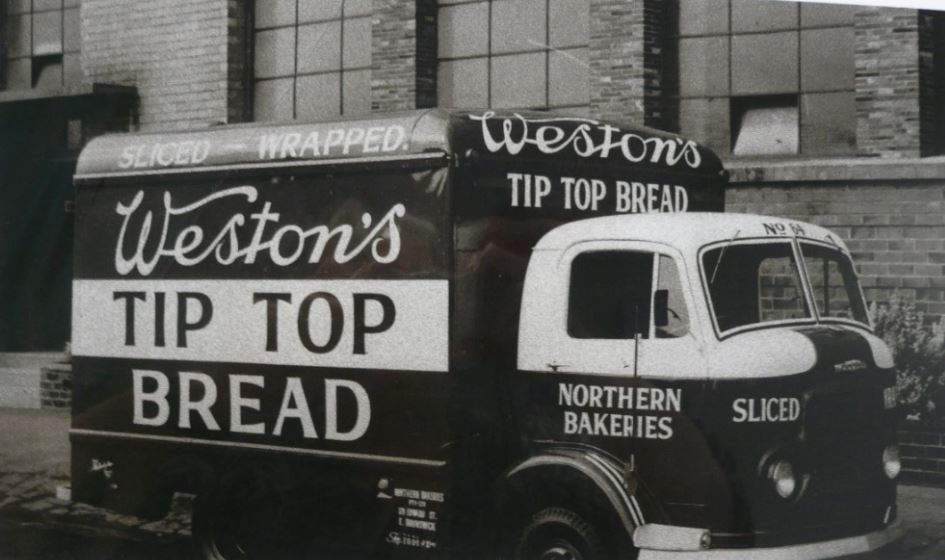
Northern Bakeries is bought out by George Weston (Australia) and becomes Tip Top

In January 1950, George Weston (Australia) Pty Ltd. bought the Northern Bakeries business for £310,000. Its owner was now a 52 year old Canadian, Willard Garfield Weston.


Argus, 10 June 1950


The business grew and ads for various employment opportunities appeared regularly in the newspapers:


Argus, 23 Nov 1955


Argus, 29 October 1956


In 1958 Weston's launched its Tip Top brand throughout Australia. 


Image courtesy Little Projects.


By the 1960s the company was known as Tip Top Bakeries and advertising had embraced the 60s look.


Miss Tip Top promotional campaign, 1969.


In the 1980s Tip Top introduced the jingle 'Good on ya mum, Tip Top's the one'. Even I, who watched very little commercial television in those days, knew the jingle. My guess is that every Australian did.

In 1993 bread production at the Edward Street site ceased and eventually the factory became derelict, home to squatters and a graffiti writer's delight.


Inside the Moderne building, 23 January 2018. (Thanks again to Sebastian who showed me around.)


Many of the old buildings were demolished in 2011 and construction work began. I only took a few photos and now I wish I'd taken more. Too late, of course.


30 August 2011.  


5 September 2011. I
I think I was standing in Edward Street looking over towards Weston Street.


The Tip Top Apartment Complex has been around for a few years now. The developers had to overcome opposition from local residents and the fear that the history of the site would be completely lost has been answered by the retaining of original buildings, restoration of some of the internal features, architecture that is in sympathy with the site's former use and an array of interpretive boards.

These photos that I took in January this year give a picture of how the complex has settled into its environment.


 I've been told these balconies are meant to represent slices of bread. 


 Looking north towards Edward Street, 23 January 2018.


The view from my back yard, 23 January 2018.


Sources:
Interpretative signs at Tip Top Apartment Complex
Weston's foods http://www.georgewestonfoods.com.au/who-we-are/gwf-fast-facts.html
Argus, 10 June 1950
Argus, 23 Nov 1955
Argus, 29 Oct 1956 
Argus, 16 Jan 1957